
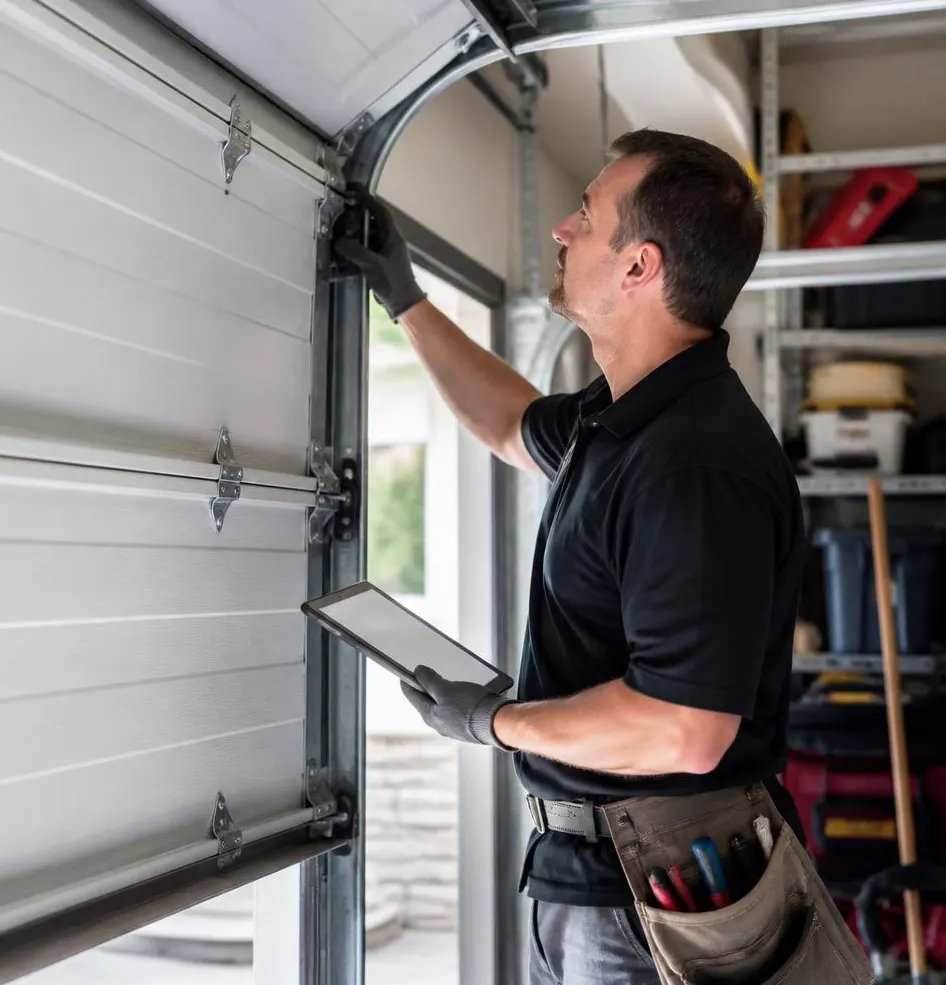
What a Technician Sees on These Calls
A few weeks after closing, we'll get a call that starts the same way: "The inspector said the door was fine." Then we show up and find a spring that's clearly the wrong size for the door, cables fraying where they wrap the drum, or an opener with the auto-reverse safety feature completely disconnected. General home inspectors check that a garage door opens and closes. They rarely pull the release cord, test the force settings, or look closely at hardware that's been through a few Wisconsin winters of road salt and slush. If you're under contract on a house, or you just moved in, here's what to check yourself before you assume everything's fine.
The Walk-Through Checklist
- Balance test. Disconnect the opener by pulling the red release cord, then lift the door halfway by hand. It should stay put on its own. If it slides down or shoots up, the springs are out of balance — meaning the opener is doing work it shouldn't, which shortens its life and can eventually strip the gears or snap a cable.
- Spring condition and match. Look at the torsion spring(s) above the door. Check for visible rust, gaps between the coils that look uneven, or a spring that looks noticeably thinner than its neighbor on a two-spring setup. Mismatched springs are common after a cheap repair, and they cause one side of the door to lift unevenly, putting stress on the opener and the tracks.
- Cables. Follow the lift cables down to the bottom brackets. Any fraying, kinks, or rust at the drum end is a sign the cable could snap under tension — usually without warning, and usually when the door is halfway open.
- Rollers. Plastic rollers crack and get brittle with age and cold; nylon rollers are quieter and hold up better through hard winters. Spin a few by hand. If they wobble, bind, or have visible chunks missing, they're close to failing and will eventually jump the track.
- Tracks. Look for dents, especially at shoulder height where a car bumper or ladder might have clipped them, and check for rust buildup at the bottom few inches — a common spot for corrosion from winter road salt tracked in on tires. Bent or rusted track sections cause the door to bind or run crooked.
- Bottom seal. This is the rubber gasket along the floor. In this area it takes a beating from snow, ice, and spring mud season. If it's cracked, flattened, or torn, you'll get drafts, meltwater seeping in, and a path for mice looking for a warm spot once temperatures drop.
- Panels, especially the bottom one. Check for rust bubbling through paint, water staining, or soft spots on the lowest panel. That panel takes the brunt of slush and salt spray all winter, and damage here is often cosmetic at first but can lead to structural weakness over a few seasons.
- Hardware and hinges. Give the bolts holding the brackets and hinges a visual check — look for rust streaks, missing bolts, or hinges that are bent rather than flat. Loose or corroded hardware is a slow-motion problem; it doesn't fail all at once, but it loosens the whole system over time.
- Auto-reverse safety test. Place a 2x4 flat on the ground where the door closes. Close the door with the opener. It should reverse immediately on contact. Then test the photo-eye sensors near the floor on each track — wave a hand through the beam while the door is closing and it should stop and reverse. If either test fails, the opener's safety system isn't working, which is a real hazard, not just an inconvenience.
Why This Matters More Here Than in Milder Climates
Garage doors in this part of Wisconsin work harder than the national average suggests. Deep cold stiffens metal and makes springs more likely to snap on a frigid morning. Road salt eats at cables, tracks, and bottom panels all winter. Then spring thaw brings mud and moisture that finds every gap in a worn seal. A door that looked fine during a dry fall inspection can behave very differently in January.
When to Call Sussex Garage Door Specialists
If your balance test fails, if you see visible spring damage, or if the auto-reverse safety test doesn't work, stop using the opener and call us before someone gets hurt or a cable lets go under tension. Our spring replacement service handles mismatched or worn-out torsion springs correctly, matched to your door's actual weight — not a generic swap. If the opener itself is unreliable, misaligned, or the safety sensors won't calibrate, our garage door opener service can diagnose and fix it rather than replace the whole unit. And if you've just moved in and want a full once-over before winter, that's exactly the kind of maintenance visit worth scheduling now.
If you've recently bought a home in Sussex, WI or anywhere nearby in Waukesha County, give Sussex Garage Door Specialists a call before the cold really sets in. We'll check everything on this list and handle whatever needs fixing, so your new garage door works the way it should all winter long.