
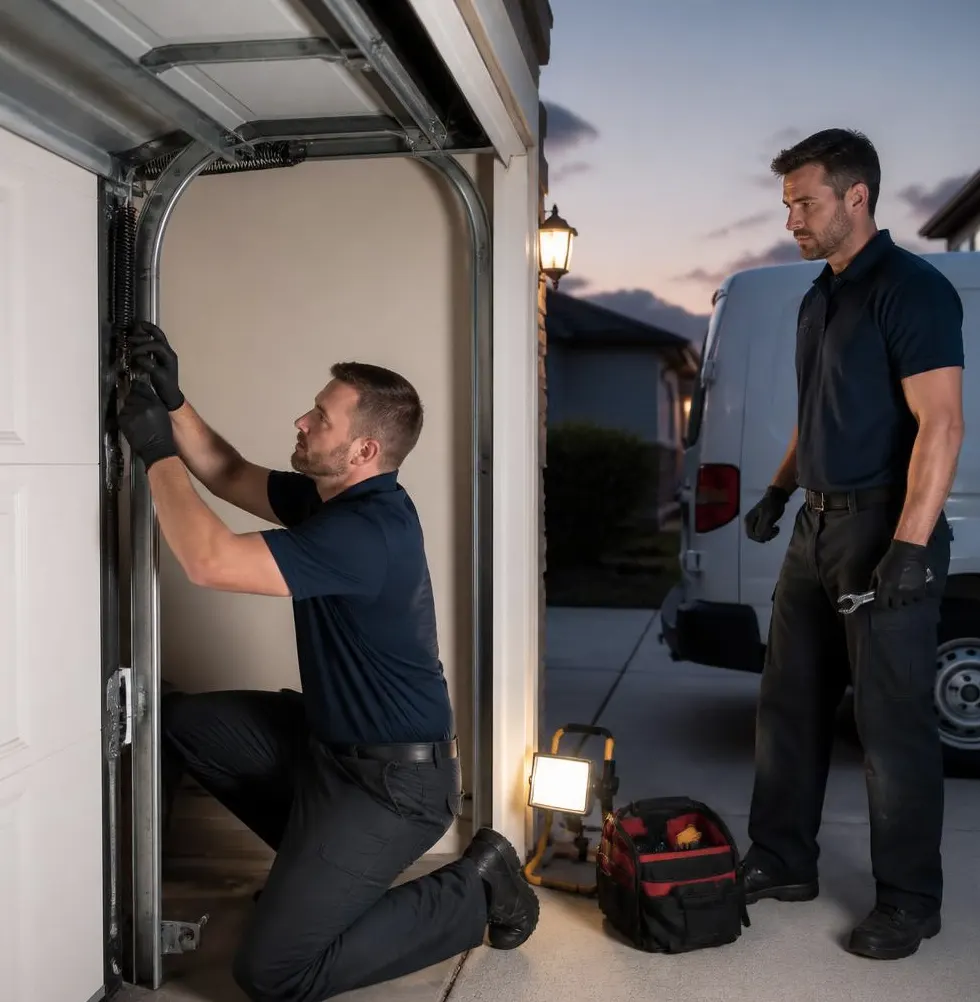
The Moment You Notice It
You pull into the driveway, hit the remote, and watch the door start its way down. Then, a few inches from the floor, it stops, shudders, and climbs right back up. Or maybe it never even gets that far — you press the button and the door just sits there, or inches down an inch before stopping cold. Either way, you're standing in the driveway with a door that won't do the one thing it's supposed to do, and the temptation is to yank the emergency release and deal with it later. Don't. This behavior is almost always the opener or the door telling you something specific, and tracking it down usually takes less time than you'd think.
Two Patterns, Two Starting Points
Most calls about a non-closing door fall into one of two camps:
- Closes, then reverses. The door travels most or all of the way down, then suddenly reverses direction and goes back up, sometimes repeating the cycle every time you try.
- Won't close at all. You press the button and get nothing, a brief motor hum, or the door moves an inch and stops.
The first pattern usually points to a safety system doing exactly what it's designed to do — detecting an obstruction, real or false. The second points more often to a mechanical bind or a power issue. A technician checks both in roughly the same order, because the easiest and cheapest causes sit at the top of the list.
1. Photo-Eye Sensors
Every garage door opener installed in the last few decades has two small sensors mounted a few inches off the floor on either side of the track. If anything breaks that invisible beam between them — a stray leaf, a bike tire, a cobweb — the door will not close, or it will reverse the instant it starts.
What to check: make sure both sensor lenses are clean and free of dust, pollen, or the grime that road salt tracks into a garage over winter. Look for a solid LED light on each unit; a blinking or dim light usually means they're misaligned. Even a sensor that's been bumped slightly out of position by a stored bike or a snow shovel leaning against it can throw the alignment off by just enough. The fix is usually a gentle realignment and a wipe-down, and it takes five minutes.
Condensation Makes This Worse Here
During spring thaw, warm days and cold nights can leave a thin film of condensation on the sensor lenses, especially in an unheated garage. That moisture scatters the beam just enough to cause false reversals, even though nothing is physically blocking the door.
2. Obstructions and Debris on the Track
If the sensors check out, the next stop is the track itself. Leaves blown in during a fall windstorm, salt and sand residue from winter boots and tires, or a buildup of ice along the bottom of the track can all create enough resistance that the opener's force settings interpret it as an obstruction and reverse the door.
The fix here is straightforward: clear the track, wipe down accumulated grit, and check for ice forming along the bottom seal during a cold snap. A light coat of garage-door-specific lubricant on the rollers and track helps prevent debris from sticking in the first place.
3. Limit and Force Settings on the Opener
Openers are programmed with a travel limit (how far the door should move) and a force setting (how much resistance before it stops or reverses). Temperature swings change how metal springs and tracks behave — a door that closed fine in September can start misbehaving once overnight temperatures drop. If the limits were set when the metal was slightly expanded from summer heat, a hard freeze can throw them off just enough to trigger a reversal near the floor.
A technician checks these settings next, since adjusting them is quick, but it's also easy to mask a bigger problem by cranking up the force instead of finding out why the door needs more force to close in the first place.
4. Rollers and Track Alignment
Rusted, worn, or bent rollers create drag and uneven movement, which can trip the force sensor. In this area, road salt tracked in on vehicle tires and boots accelerates rust on metal rollers and track hardware faster than in drier climates. A bent track — often from a car bumper tap or a snowblower collision — will bind the door at the same spot every time. Worn rollers get replaced; a bent track gets reshaped or swapped out section by section.
5. Springs Under Tension
If the door reverses right as it nears the floor, or won't budge past the first few inches, a losing spring is a strong suspect. As torsion or extension springs weaken, the opener has to work harder to manage the door's weight, and that extra strain often gets read as an obstruction. This is also a safety issue: a spring under tension can cause serious injury if handled incorrectly, so this is strictly a job for a trained technician with the right bars and clamps, not a weekend project.
6. The Opener's Logic Board
If everything mechanical checks out and the door still won't cooperate, the circuit board inside the opener itself may be failing. Power surges from summer thunderstorms are a common culprit for this kind of damage. Replacing the board, or in some cases the whole opener unit, resolves it.
When to Call Sussex Garage Door Specialists
If you've cleaned the sensors, cleared the track, and the door is still reversing or refusing to close, it's time to call in a technician rather than keep adjusting force settings on your own. Sussex Garage Door Specialists will diagnose the full system — sensors, track, opener settings, and spring tension — and handle whichever repair the problem calls for, whether that's a straightforward Garage Door Opener Service to recalibrate limits and replace a failing board, or a Spring Replacement done safely with the right tools. We know how Waukesha County winters and spring thaw stress these systems, and we fix the actual cause instead of just resetting the force dial.
If your garage door in Sussex, WI is closing and reversing, or won't close at all, give Sussex Garage Door Specialists a call today and we'll get it working reliably again before winter sets in.